

















Webflow has earned a strong reputation as a powerful visual development platform, but it is not the perfect solution for every designer or no-code developer. Pricing, complexity, collaboration workflows, scalability limits, and ecosystem constraints often push professionals to look elsewhere. Fortunately, the no-code and low-code landscape has matured significantly, offering tools that are more specialized, more flexible, or better aligned with specific project goals.
TLDR: Webflow is powerful, but several tools now surpass it in specific areas like app building, rapid prototyping, ecommerce, scalability, and collaboration. Platforms such as Framer, Bubble, Glide, Softr, and Editor X each offer distinct advantages depending on your workflow and project scope. Choosing the right alternative depends on whether you prioritize visual design precision, full-stack functionality, speed of deployment, or business automation.
Below, we examine serious alternatives to Webflow that designers and no-code developers should consider. Each tool has strengths that may make it superior depending on your objectives.
Why Look Beyond Webflow?
Webflow excels at visual website development with clean code output and strong CMS capabilities. However, common concerns include:
- Steep learning curve for beginners
- Pricing that scales quickly as projects grow
- Limited native app-building functionality
- Complex interactions that can become difficult to manage
- Restricted backend logic without third-party integrations
For designers seeking smoother UI control, or no-code developers building more advanced web apps, these constraints can become friction points.
Top Tools Better Than Webflow for Designers and No-Code Developers
1. Framer – Superior for Modern Marketing Sites
Framer has quickly become one of the most compelling alternatives to Webflow. It combines visual editing with powerful animation control and a polished interface that feels natural for designers.
Why Framer can be better than Webflow:
- Faster learning curve
- More intuitive interface
- Built-in advanced animations
- Excellent performance optimization
- Simplified publishing workflow
Designers who prioritize speed and motion design often find Framer more fluid. It feels closer to modern design tools while still providing production-ready output.
Best for: Marketing websites, startups, personal brands, visually rich landing pages.
2. Bubble – Best for Full Web Applications
If your goal extends beyond websites into fully functional web applications, Bubble is considerably more powerful than Webflow. It includes built-in database management, workflows, logic conditions, and API capabilities.
Advantages over Webflow:
- Full backend database integration
- Complex user workflows
- Membership systems without external tools
- API integrations and automation
- Custom logic without writing code
Webflow can simulate app functionality with integrations, but Bubble was built specifically for this purpose. For SaaS founders and startups validating ideas, it often eliminates the need for a development team.
Best for: SaaS platforms, marketplaces, dashboards, internal tools.
3. Glide – Simplicity and Speed for Internal Apps
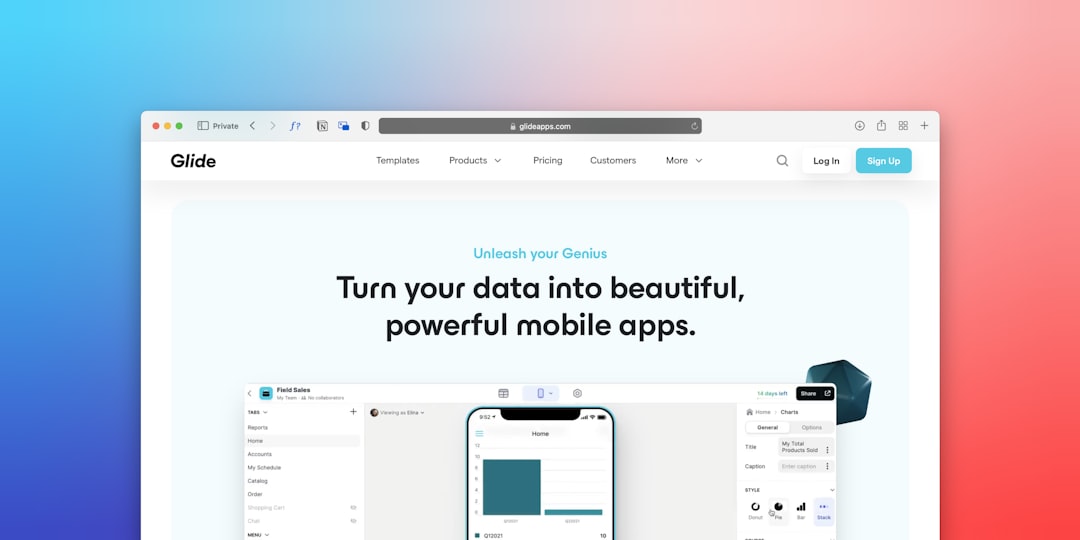
Glide is purpose-built for turning data into applications. Unlike Webflow, which emphasizes visual layout control, Glide prioritizes function and data-driven builds.
Why Glide stands out:
- Extremely fast deployment
- Simple logic system
- Automatic responsive behavior
- Direct integration with spreadsheets and databases
For businesses that need operational tools rather than marketing sites, Glide delivers better efficiency and lower complexity.
Best for: Internal business apps, client portals, inventory systems.
4. Softr – Business Tools Without the Overhead
Softr bridges the gap between beginner no-code platforms and more advanced systems like Bubble. It integrates seamlessly with Airtable and other data sources to create client-facing or internal business apps.
Key advantages:
- Faster setup than Webflow CMS
- Built-in authentication
- Pre-configured blocks and templates
- Lower barrier for non-technical teams
Where Webflow requires structured CMS configuration and logic setups, Softr simplifies the process for business-focused use cases.
Best for: Membership sites, job boards, directories, client dashboards.
5. Editor X (Wix Studio) – Advanced Responsive Control
For designers focused heavily on responsive precision, Editor X (now evolving under Wix Studio) competes directly with Webflow’s layout capabilities. It offers flexible grids, breakpoints, and docking systems that allow high-level control.
Why it may outperform Webflow:
- Highly refined responsive behavior tools
- Integrated business solutions
- Simplified hosting management
- Strong ecommerce ecosystem
For agencies serving small-to-medium businesses, it can be more scalable in terms of operational management while maintaining strong design flexibility.
Best for: Agency workflows, ecommerce businesses, content-rich websites.

Comparison Chart: Webflow Alternatives
| Tool | Best For | Ease of Use | Backend Capability | Design Flexibility | Scalability |
|---|---|---|---|---|---|
| Framer | Marketing sites | High | Moderate | High | High |
| Bubble | Web apps, SaaS | Moderate | Very High | Moderate | Very High |
| Glide | Internal tools | Very High | Moderate | Low to Moderate | Moderate |
| Softr | Membership sites | High | Moderate | Moderate | Moderate |
| Editor X | Agency websites | Moderate | Moderate | High | High |
How to Choose the Right Alternative
Instead of asking which platform is objectively “better” than Webflow, consider:
- Project Type: Static site, marketing funnel, SaaS platform, or internal tool?
- Team Composition: Designers only, mixed technical team, or non-technical founders?
- Scalability Needs: Will the project evolve into a complex system?
- Time to Launch: Is rapid deployment essential?
- Budget Forecast: How will costs grow over time?
No-code maturity means specialization. Tools are now optimized for specific outcomes rather than broad use cases. Selecting a focused platform often leads to better efficiency and fewer technical compromises.
Final Thoughts
Webflow remains a leading platform for visual website development. However, it no longer exists in a category of its own. Framer rivals it in speed and design elegance. Bubble surpasses it in backend functionality. Glide and Softr redefine operational no-code development. Editor X strengthens responsive control for agencies and businesses.
The most effective designers and no-code developers are platform-agnostic. They evaluate tools based on business requirements, scalability, and workflow compatibility rather than brand reputation.
In 2026, the no-code ecosystem is robust enough that you are not limited to one approach. Choosing the right alternative to Webflow is less about finding a replacement and more about selecting the tool built precisely for your intended outcome.
Professional growth in this space increasingly depends on adaptability, strategic selection, and understanding each platform’s strengths — rather than loyalty to any single tool.